Floods and grit.
April 17, 2026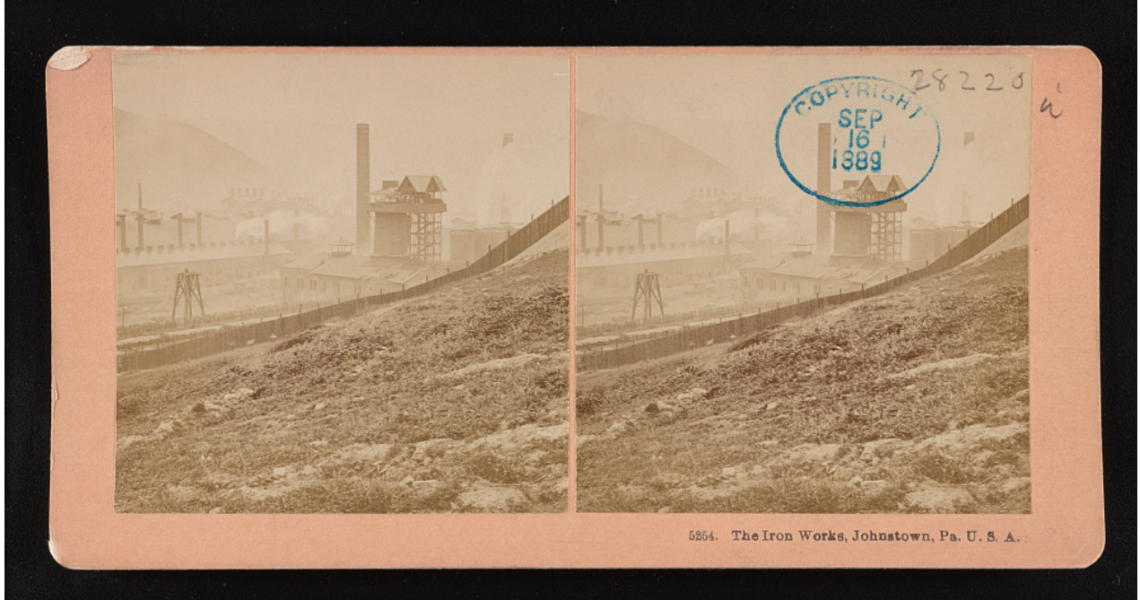
Floods and grit. That’s what we have so far in looking over These Restless Hills. But what of it? What is the story? Beyond a catastrophically damaged lead character, what do we know of the people and the times we’re witnessing in the book? I did a fair degree of research regarding it but not all of the research was just for TRH. With the previous books, I had already gotten some idea of the history of the 1889 flood and, as a child of Johnstown myself, it’s virtually impossible to grow up in the city without some awareness of the floods. With that background, including some important works such as David McCullough’s landmark The Johnstown Flood, I had a solid feel for the era and the time.
Still – there were special directions of the research that were new, because they concerned persons. What were they wearing? We’ve all seen period piece dramas set in the Gilded Age, so again we have some sense given these reference materials. But what were the clothes called? How would that shirt have felt? What did he call his hat? What kind of horse was Amos? What firearms would a maniac like Houghton have on his person?
Perhaps the most outrageous element of TRH is not Houghton nor the historic, destructive flood. My personal vote for the most outrageous element is the actual reality of the Pennsylvania Coal and Iron Police. Had I invented that outfit for the purpose of the novel, my editor (or the initial reader of the submitted manuscript) might well have told me to start over, because there’s no way such a thing could be real.
It was. I’ve gone into enough detail about them in the book that I don’t really want to get bogged down here, but suffice to say that the CIP was a rogue agency, consisting of brigands, thieves, and many others…in the immortal words of Obi-Wan Kenobi, “you will never find a more wretched hive of scum and villainy.”
Nonetheless, the idea of the grit and the realism – the fury and the hate that people would have felt and been feeling in 1990 – was the dominant factor in the way that I brought the prose to the page. I wanted noise and smells in particular, which are a special type of challenge to describe (at least for me), because I think because we are sight-dominant creatures, we “picture” the information in a novel visually first, and by the vast majority of all processing, from beginning to end. I’m not sure if we’ve always been this way, and of course, we’re all familiar with people who were born without sight or lost it, and they learn to favor other senses and become more attuned to it. Still and all, however, for many of us, vision is the single most important and powerful of sensory aspects. It is perfectly possible to follow the story in a movie or TV program without any sound. There would be gaps, of course, but possible to do so. Not so much with smell and taste. And I think because those of us alive today have never not been in the presence of visual storytelling in the form of motion pictures and other media. Were readers in 1850 more perceptive of other factors that would have been included in what would have been a contemporary work of the time? Unfortunately, there’s really no way for us to know. While we can certainly analyze the text of a book nearly 200 years old, we don’t have the ability to survey readers to try to get their understanding of the text and what they would have been picturing.
All of this is to say that my writing in TRH was intentionally vision-forward. I wanted an action-movie type of brace for the reader; that said, the texture of the experience of the setting depends on a lot on evoking sound, smell, and taste in the reader. Johnstown in 1889 would have had many, many interesting smells. It would have been a very loud place as well, with the noise of the mills, the people, the animals, and the mines. All of this comes from a number of intertwined layers that are, in all frankness, hard for me to pull apart. A lot of this comes down to subjective judgment and “feel” whenever I’m writing something; this also underscores the most important side of writing, at least in my view – that of rewriting (and editing, which includes self-editing and working with a capable editor.) I think this last part, at least for me, is both the second most important part and the most difficult part; it is the second most important part because, at least for me, momentum during the first draft is the most important part. It’s also some of the most difficult part because I see how many mistakes I made during the first draft, and I do tend to sweat details…especially in matters of verisimilitude. I know enough and have enough experience to know that mistakes can creep into work, and there will be some there despite best efforts otherwise. At the same time, however, one can’t be so consumed with a “perfect” single sentence or the absolute proof of a single fact that might be in dispute or have conflicting or competing accounts. Never let the perfect stand in the way of the good. Progress is motion.