Coal Dust Rivers
February 3, 2026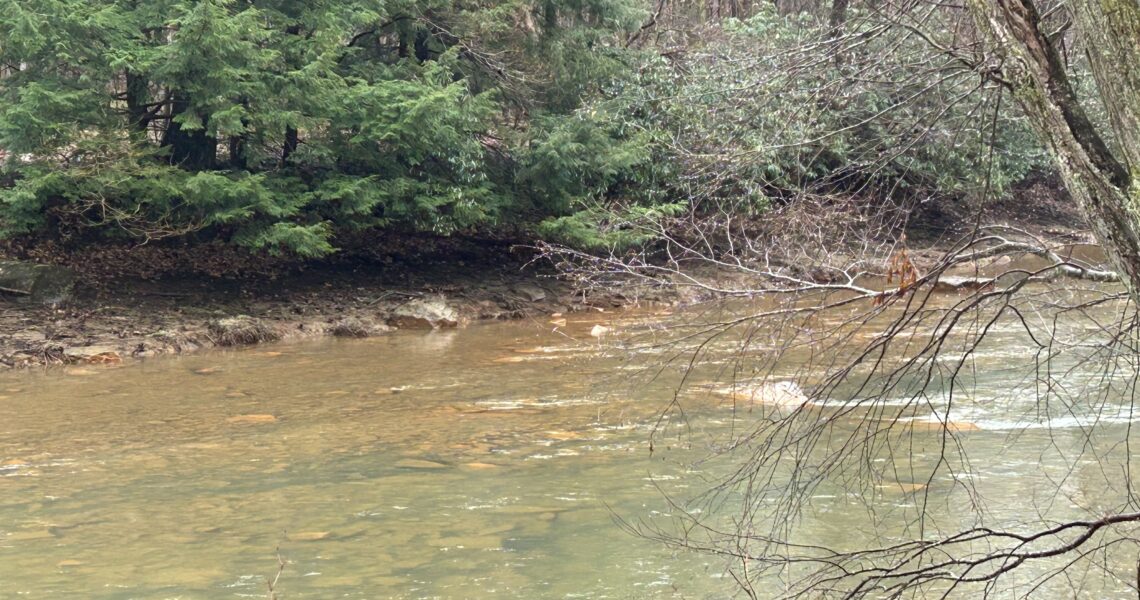
Taking a break from the historiography of my own writing with this blog entry, to note my more formal titling of it from “blog” to Coal Dust Rivers. I may use that title elsewhere too, but for now, I’m going to place it here as it, at least to me, is evocative of the combination (or collision) of history and historical forces that I tend to study: that of change and continuity, the interaction of the industrial and the environmental, the coexistence of the human-built world and the natural one.
It’s not easy, after all, to be someone who cares about the earth and, at the same time, still feels deeply about the prosperity of a region that has now turned to be far less so. The continued pollution has, for the most part, abated – but the thousands of jobs that were once here are now gone as well. Just as a brief note on this – during an interview I recently conducted for a new project I’m working on, my interlocutor told me that Johnstown, around 1970 or so, had 23 live music clubs. By the late 1970s, when Bethlehem Steel was rolling back its operations in the city, there three.
The slowdown and eventual demise of Bethlehem Steel played an outsized role in many communities throughout the nation – Gary, Indiana; Sparrows Point, Maryland; Orchard Park, New York; Johnstown, Pennsylvania. The big steel mills were of course the most visible and evident costs associated with operating in the steel industry and then unavoidable symbols of the decay once they were closed. Brownfields and blights in many communities, they still stand as stark warnings of economic turns of fate and how the fate of an entire city might be defined.
There are many, less visible – or at least not as prominent – signs as well: vacant storefronts, crumbling homes, empty churches. One of the biggest ones for me is the sight of the old ethnic social clubs scattered around a town where there is no longer any people, bound in family traditions and folkways, brought together by economics and job functions – now empty. Where there was once beer, dancing, and a shared sense of identity (whether Slovakian or Italian or Polish), only silence remains. Perhaps the ghosts and memories still dance, invisible to us all.
And then there are the mines.
Much ink has been spilled about the amount of blood spilled in the mills and in the mines alike. Right now, I’m not sure which have claimed more over the years; certainly working conditions have markedly improved since the middle of the 19th century in either setting, but it’s likely now that coal mining is by far the more dangerous and deadly of the two. One can hardly visit any small town in Pennsylvania or West Virginia without seeing some type of monument to coal miners killed at some point in the history of the town. Avondale, an anthracite coal mine in eastern Pennsylvania, set the bar for horrific mine disasters with 110 killed in a single incident in 1869. The owners of the mine saw fit to introduce efficiencies by having only one route of access and egress; the easily predictable (even in 1869) disaster occurred when a conflagration blocked an escape and 108 of the 110 asphyxiated or were burned to death. Two more men were killed when attempting a rescue. There was, of course, no real legal consequence for the owners of the mine, despite inquests finding culpability. The mine, in fact, was in operation for decades afterward.
While Avondale spurred the Pennsylvania legislature to create new legal safety obligations for mine owners, the industry hardly noticed. Johnstown itself was the site of a massive mining disaster in 1902, once again a mix of suffocating gas and an explosion, killing 112, in the Rolling Mill Mine Disaster. The mine operated until the early 1930s; today, one can see the sealed entrance of the mine in a hillside above Johnstown’s downtown area, overlooking one of the massive steel mills that the mine would have supplied. This represents one of the more unusual circumstances in mine location, in that the “underground” mine was higher in elevation than the city next to it, as it curled and unfolded for miles into the hillside next to the city. Only in hilly and complicated Appalachia would such a thing be possible.
Such tales are the tales of the human cost of what I’ve come to call the “heavy Industrial Revolution,” featuring coal, railroads, and steel supplanting the first “Industrial Revolution” of steam power and textiles. But in addition to these staggering costs, and their accompanying staggering gains, there are innumerable externalities with which we still content today—namely, our current prosperity and the environmental degradation that has occurred.
This is, in essence, why someone alive today, in 2026, can do as follows: own an automobile with safety features unimaginable in 1926, powered by a mix of energy sources (either petrochemical or electro-mineral), drive to a flowing body of water, walk toward or into that water with synthetic, warm, insulated, waterproof clothing, use either a synthetic (such as fiberglass or carbone fiber) or natural fiber rod (such as bamboo) … and catch a fish. Obviously, I’m skipping over a few important parts, such as learning how to fish, the line, the lure, the reel, the psychological cost of the interest-bearing payments one generally makes to afford these things.
At the same time, that water – now blessed with fish whereas in the 1920s almost all aquatic life would have been largely extirpated – carries the legacy of the coal and steel in terms of contaminants. The trees guarding the sides of the river; the birds in those trees; the autumn leaf twirling downstream past the angler’s waders…all signify important continuity and dissonant change in both nature and character of the stream and the person.
Hence: Coal Dust Rivers.
Welcome.