A Brief Digression to a Town Called Wehrum
February 3, 2026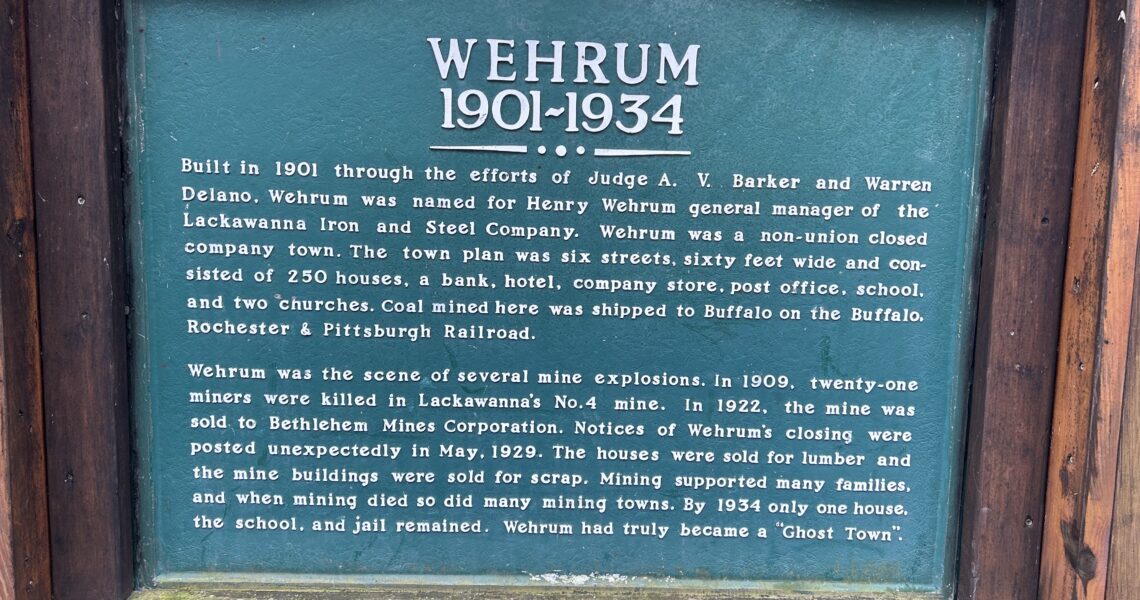
Let’s continue just briefly with the ideas of the renaming of the blog, as it might be illustrative of the type of scene and context that creates the creative impulse. It imbues with imagery, empowers the nerves.
Like any ghost town, it’s like it was never here, but still it lives.
The waters – or to be more accurate, half the waters – radiate with an orange intensity belying the speed of its rushing current. It’s the first day of spring and the equinox gives us half the day as day, the other half as night…another halving, as old as time itself. The day dawns rainy, gray, and cold, and spring seems far away; tell winter its time is done and the laughter echoes. It’s spring only on the calendar.
Taking a look around, the foundations of the town’s buildings are the only things still visible, between that roiling half-orange creek and the rain-soaked woods. Green buds just beginning to break out vie for light within their thin ice encasement, the occasional drop of water hitting the thick, soaked red-brown layer of leaves, the remnants of autumn seen again for the first time in months after the last of the snow melted away. One can smell that signature sweet smell of decay, tracing atop the smell of the cold rain. In one small miracle, the half-orange river holds no odor.
A sign reads here –
Built in 1901 through the efforts of Judge AV Barker and Warren Delano, Wehrum was named for Henry Wehrum[,] general manager of the Lackawanna Iron and Steel Company. Wehrum was a non-union closed company town. The town plan was six streets, sixty feet wide and consisted of 250 houses, a bank, hotel, company store, post office, school, and two churches. Coal mined here was shipped to Buffalo on the Buffalo, Rochester & Pittsburgh Railroad.
That seems an able and high-enough level of explanation for those curious few wandering by the ghosts. This is the Ghost Town Trail and a map still marks the town’s name: Wehrum. In the reality of this cold spring morning, we recognize it no longer can be called a town of any type. It is truly a ghost town, like many of its neighbors.
The “ghost town” in our culture is arguably more associated with visions of the “Old West” of the late 19th century, now tourist traps and titles of various Hollywood blockbusters – think Tombstone or Deadwood. Their new iterations and invitations are not so different than they were in the late 1800s – separating the passersby from their money. The ones here hold some differences, however. The towns commemorated in the Ghost Town Trail between Ebensburg in Cambria County and Blacklick in Indiana County are no tourist traps. The half-orange river is Blacklick Creek, and it strains as it straddles the difference between the orange metals, acids, and alkalines pouring in and the otherwise clear and dark current tumbling downstream over rocks, much as it did before any people were here at all.
This is a place of great collision. On this day, it is a collision between winter and spring, and winter holds the high ground despite the equinox. Time collided with the homes that once stood here and it has triumphed, but the remains sunk stubbornly into the clay soil resist time’s inexorable cascade. The railroad that once cut through the woods is now gone, replaced by a quiet trail for those on bicycles or on foot. The mines which once produced the coal to fire the industry of Western Pennsylvania and New York are as silent as any grave, but still the reservoirs of acids and alkalines held deep in those shafts leech their burning compounds into the water and stand athwart much and perhaps all life that might otherwise take root. The trees – cherries, oaks, maples — grow today where once there would have been none, and they stand silent guard over the shadows of memory of the people who once lived in Wehrum.
It is so quiet here…but, if one listens closely enough, one might still hear the ghosts.