The Language of Ghosts
March 4, 2026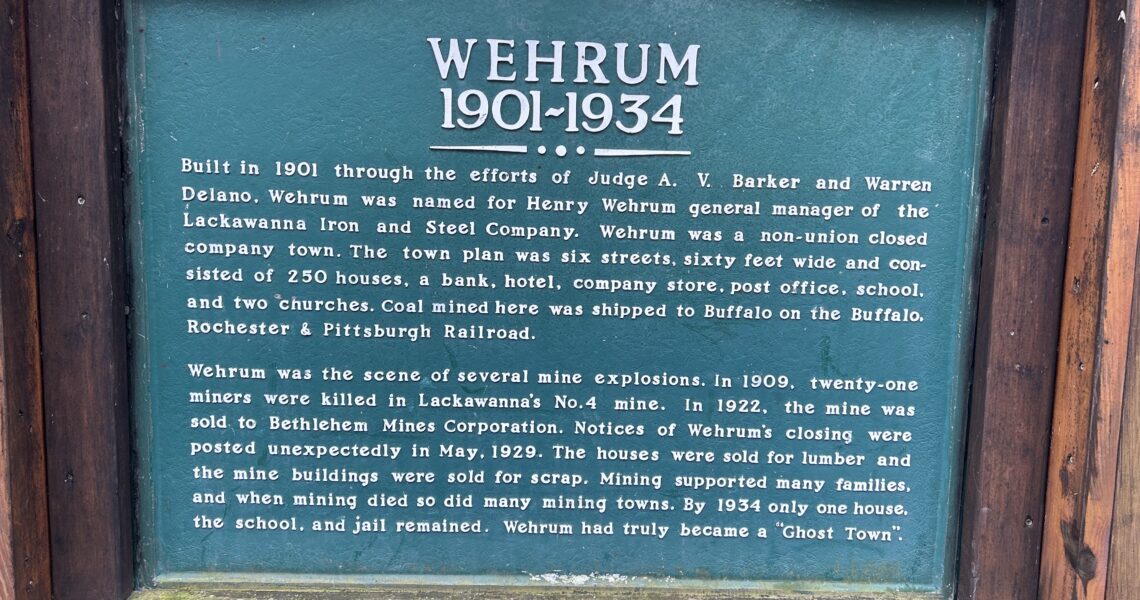
The sign here at Wehrum reads:
Notice of Wehrum’s closing was posted unexpectedly in May, 1929. The houses were sold for lumber and the mine buildings were sold for scrap. Mining supported many families, and when mining died so did many mining towns. By 1934, only one house, the school, and jail remained. Wehrum had truly become a ‘Ghost Town.’
Imagine the capacity for your hometown to simply…close. Your job is not only gone, but they also tore your house down and sold it for scrap and lumber.
Your town disappears, moves, leaves, striking a bolt not only of change but downright disruptive impermanence. The people go…the ghosts remain. This can be observed on the trail, as one searches for signs of life in this place of great and quiet collision. For just a minute, there’s a pause in the orange, as if you are the only witness to the end of an era and you’ve seen the acid expunged from the soil and waters.
Then it’s orange again. The phrases for such things abound – regress to the mean comes to mind — but as real as the regression is, the mean is but a small part of the history of the area. It shrinks to the infinitesimal when considered in the context of Deep Time, which is the only time that truly matters, as it makes the human footprints as ephemeral as the mist of one’s breath on this frigid, damp morning.
It is appropriate, then, that this chilly stroll occurs along the Ghost Town trail. There are many marks of a former life here, a different life from what many know now…for while some mines still work, many others have closed. The old iron furnaces nearby, like the Eliza furnace in Vintondale, stand testament to this, as do the quiet, largely empty, and sometimes-disappeared remnants of the massive Bethlehem Steel facilities upriver in Johnstown.
After all, what really is a ghost? A spirit? A representation of the departed? Perhaps. Or a different kind of spirit, something that is out there in another dimension? Maybe it is a different type of energy entirely, a spirit that we see in our mind’s eye, not psychic so much as the work of our imagination building from a pattern that we see. Our eyes take the measure while our minds build the breadth.
Such ghosts can tell us many things, provided we stay silent. Our vision and our thoughts look out at the gossamer mist twisting in the raw wind, we see the pattern that each raindrop makes as it lands in the mud and the blades of grass just now beginning their cycle of life from the long quiet winter grave. This augury means something only as we see it, and the truth of it is so basic it might be mistaken for the trite – life is change, until the end…and change will continue even after that moment.
Scars that disappear after life nonetheless carry through the generations. The weathered stones remain on land, just as the Blacklick crashes through the cold winter-spring air. The stones cut the pattern in the mind; some tracing out the buildings which once stood here, and the other stones, not so visible, still might have only the weathered remnants of writing of names and dates. These headstones aren’t on the easement of the Ghost Town Trail; a private citizen owns the cemetery ground and the tourist guides state that one must be careful to seek permission to enter that space even as the bones of Wehrum –or at least its people—await visitors.
Mysticism and legend suggest that the “language of the birds” is a language shared by birds and inter-dimensional spirits and beings, like angels. It is the language of fortune-telling and fate, destiny and divine will. This belief is shared among and between many cultures and traditions, including the Norse, the Kabbalah, the ancient Greeks, and medieval and Renaissance alchemists. If one learns this gnostic and secret tongue, one might understand the universe, even the mind of God. The drawers of the tarot are said to trade in it; the ancient mystic practitioners of the Middle East included Persian magicians and King Solomon himself, a third eye opened to view the mechanisms of the divine mind and secrets of the universe.
The language of ghosts, by contrast, is that of the interested if untrained eye. For certain, the birds speak on this first morning of spring, welcoming the frigid equinox. Robins and sparrows cling to the branches along the half-orange Blacklick. What John Dee or King Solomon or Odin would have to say in translation can’t be known; what can be known this moment, however, is that there are likely more of them now among the whispers of the ghosts than what would have been during the times when the coal washer was working and the mines active.