What, then, can the ghosts tell us? Just a bit.
February 3, 2026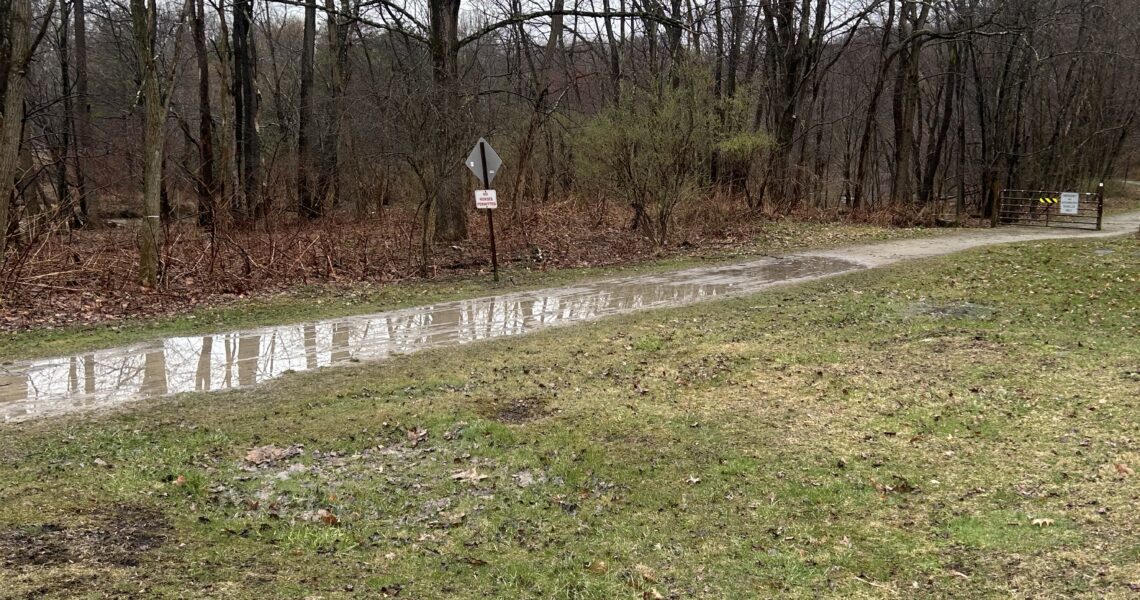
So with that last entry, we had a look at number of things. The primary aspect I attempted to imbue was the setting’s intertwinement with history itself. Of course, it would have been a far different excerpt had Wehrum never existed. Another section of woods, which hadn’t had a human settlement, much less a company town, would be a setting which would have resulted in a far different essay. It might have been a more technical one; for example, something along the lines of an environmental science essay which still could have reported on the impact of human action on the environment, through acid mine drainage or, in a different setting, a surface mine which would have altered the contour of the land itself and thereby caused some other type of change.
Another possibility would have been something a bit more lyrical, or something about the efforts at wildlife conservation, through aquatic biology and fishing, or through hunting and wildlife management. It could also go in a different direction, with an exploration of how the public land easements creating the Ghost Town Trail, tracing its way through Cambria and Indiana Counties, abutted private property interests and rights. These could represent any potential and fruitful direction for an essay, but it always starts with the setting itself.
With the area around my hometown of Johnstown, the setting is as varied as the writer could potentially want it to be. For someone who is uninterested in the area, for example, there’s nothing of note other than another chunk of Appalachian topography…ahh, yes, the Rust Belt. Such a shame…moving on…
By contrast, there’s a person who thirsts for knowledge, for going as into as much detail as possible about a thing, a concept, a person, or a place. For some, there’s only one of these deep dives; for others, there are many. It may be a vocational calling or it may be a hobby, or something completely different.
Then, there is what is likely the vast majority: somewhere in the middle, ranging from passing and mild interest to teetering on the brink of a deep dive. The role of the setting and the writer’s description can often be what shades or alters that reader’s perspective of an area. The writer has the opportunity to “convert” a casual reader into an enthusiast; this possibility rapidly collapses, however, as soon as the reader sense that the writer is attempting to do exactly that.
So then – instead, we continue with the inveiglement, an exploration of setting with the cautious subtext of its importance to the reader; the setting becomes a part of the story, even a substory. I mentioned earlier that my original intention had been to write local history of the Johnstown area without the flood. As I learned, that is impossible to do…or, at least impossible for me, as my own direction was aimed toward that thematic importance of the setting. The history of the floods is inextricably woven with Johnstown, at least insofar as discussion of setting. Economic history? Floods, and even the creation of dams in some cases. Geography? Floods, given the topography and even why people came to the area at all. Social history? Impossible to discuss without a recognition of the scars left on the neighborhoods and their residents by the floods. I would venture so far as to say that there isn’t a person in the area who hasn’t been impacted by the floods in some form or another – just in something as small as a heightened baseline awareness of their importance to others in their lives.
Perhaps Johnstown isn’t even the greatest example of the intertwinement of setting and theme, given the obvious prominence of the disasters in the city’s history. I think, however, that there are many elements of its history that bear notice independent of the floods, but my treatment of them –especially as the work to date tends to traverse a couple centuries of history – would always have the floods in as a news item at some point in the narrative.
I’m not sure if there’s an instantiation moment for each and every community. I suspect that some of that would be highly dependent on the framing of the narrative that the writer chooses. Many of the smaller communities in the area, as I noted, have some type of memorial to coal miners lost, either in a single disaster or smaller incidents. In the case of Wehrum, it’s about the dissolution of the town in the face of poor production. Its demise and now location along the “Ghost Town Trail” provides its own contexts.
What, then, can the ghosts tell us? Just a bit.