A Return to an Underrated Battlefield
July 19, 2026
To say that history is layered is to express possibly one of the tritest and superficial forms of historical depiction. Of course there are layers: time, place, people, things, artifacts, and the list goes on. There are the quite tangible layers to the archeologist as well – the stratigraphy of a dig, particularly in an ancient area with a long history of inhabitation. Urban explorers can uncover decades of extraordinary understanding of a city that had never been known before; the larger point is that the layers are what one makes them.
I visited Bushy Run Battlefield in Harrison City (Bushy Run Battlefield | Commonwealth of Pennsylvania), which I had done before…as an indolent undergrad. Now doing it a short time later as one in ancient middle age, I like to think I got a bit more out of it. The battle itself was small in terms of absolute numbers, but a hinge point in history nonetheless. In short, in 1763, a detachment of the British Army led by Swiss-born professional solider Henri Bouquet defeated a fighting force of American Indians taking part in Pontiac’s Rebellion, which occurred on the heels of the French and Indian War and prior to the major colonial convulsions which would begin soon. Had the British not been victorious, it’s hard to say what would have happened to Fort Pitt and Fort Detroit, and then a cascade of change to what we know as history might have well resulted in us leading much different lives now.
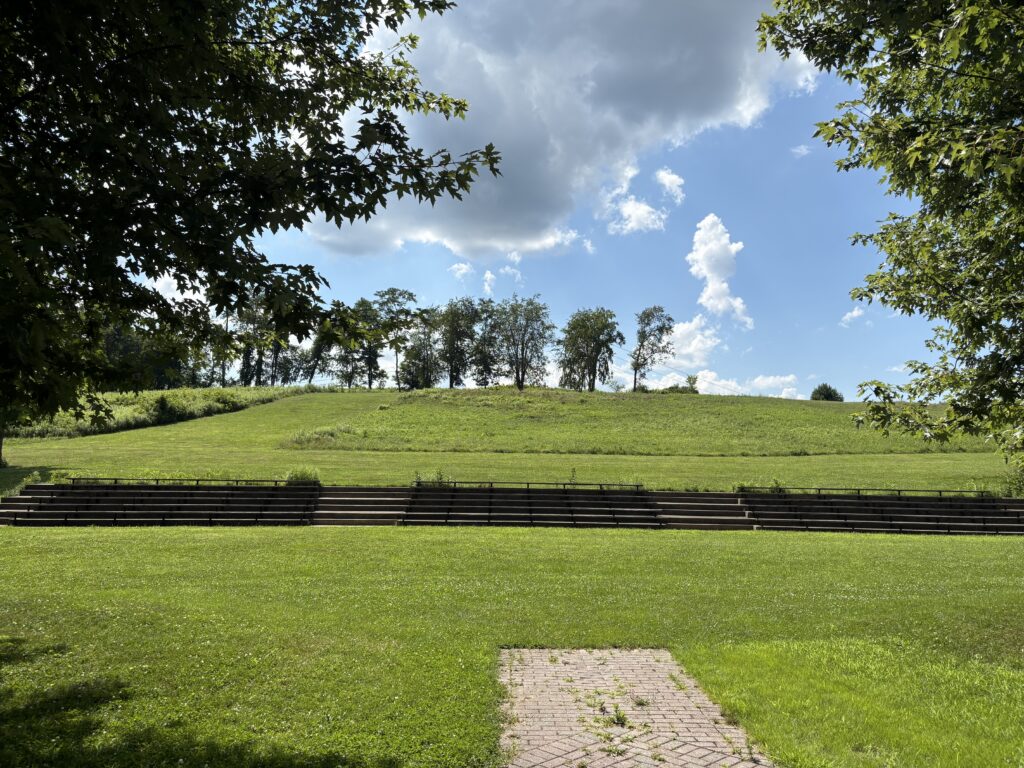
So that’s the most prominent part of the history there, but there were a couple of other things that really piqued my interest during the visit. First was the presence of the layers themselves, in the form of coal mining and farming. Next was the pressure of stakeholders over time in the area, which impressed labels on things that may have been attested to, but not really shown. This is the liminal space of fact and myth, and it is hard to say whether we would ever have the evidence to move from one space to another…yet the compulsion to push it in one direction or another is still very much present. Let me explain.
If you want a blow-by-blow account of the battlefield, it’s best to consult some other sources, starting with this one: https://en.wikipedia.org/wiki/Battle_of_Bushy_Run, which doesn’t appear too bad as far as Wikipedia goes. There are others, of course: https://www.bushyrun.org/. The battlefield itself has been well-attested to over the intervening centuries, and the Commonwealth acquired it in 1927 to conserve it as an area of historical importance. The land too had been owned by some prominent families, including that of the Wanamakers. The drawing up of the deeds from colonial times through that of the Industrial Revolution alone would be an interesting journey.
There is a spot in the battlefield property, now covered with thick, green undergrowth, disguising a sinkhole. As with so many instances in coal country, this was linked to the presence of underground coal mining in the area; subsidence is as ever-present as gravity itself. Battleground caretakers knew the hole was there and growing; a combination of state mine remediation experts and private contractors fixed and sealed the hole. Instead of a looming hole, it’s now a “bowl” filled with soil and lush green plants at the bottom of a cliff face.
We know there was a battle there, but the additional layers are important too – including the way in which things were labeled, declaimed, and otherwise “understood” to have occurred. The impact of the industrial age on a pre-colonial battle site is one example.
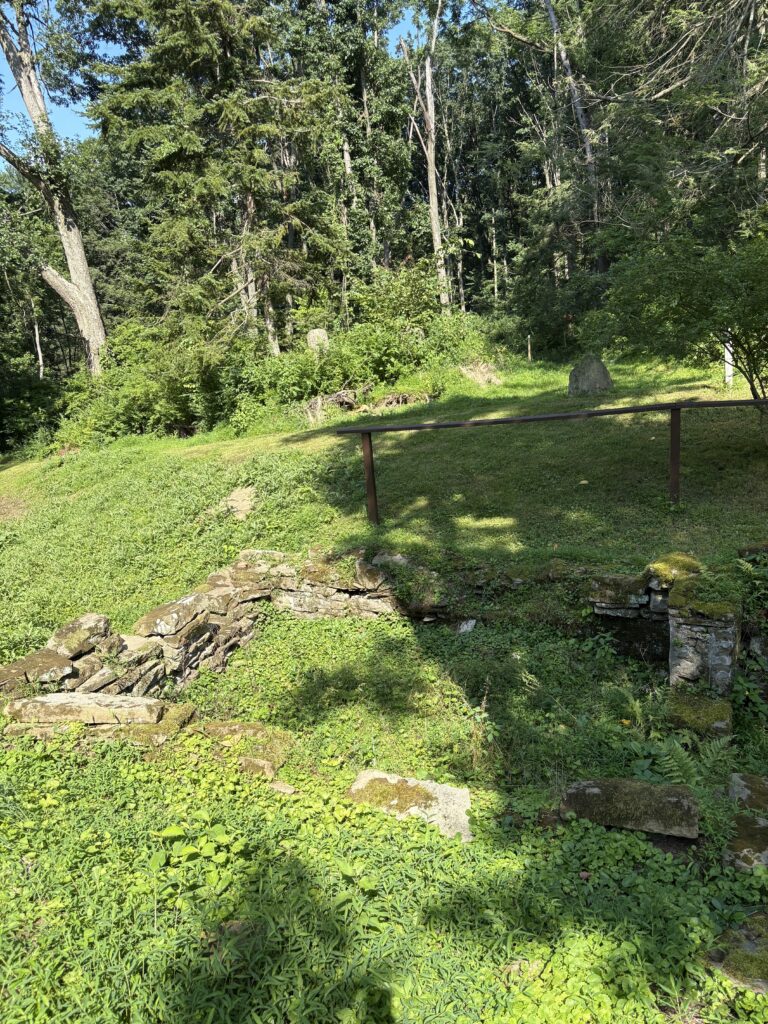
For example, part of the lore of the site was that the colonial owner of a local trading post, Andrew Byerly, marched with the British contingent and risked his own life and limb by sneaking water from a nearby stream by soaking his felt hat, and then crawling back to the wounded to give them the water. A chapter of the Daughters of the American Revolution saw a spring house on the property and concluded that must have been the site of Byerly’s derring-do…despite the fact that there was not a shred of evidence marking that point (and while Byerly is generally regarded to have been with the group serving under Bouquet, and his own wife had a harrowing story of escape just before the battle, it is unknown as to whether he actually performed the aquatic heroics.) Nonetheless, the spring house is there; if you want to picture the Byerly events with that spot, you are free to do so.
One of the better elements of having a tour guide, or at least a knowledgeable one, is the opportunity to learn after the guide points out nearly-hidden history. In such a case, one might be poised to easily miss a brass plaque hugging the ground. The staff makes sure the plaque is still visible, but still, it’s not hard to miss, especially when one doesn’t take that trail. It’s not on the “battlefield” proper, but it’s still a remarkable thing when one considers that it was a plaque placed by a troop of Boy Scouts in honor of their mothers. The date: Sunday, May 12, 1935, Troop 1, Trafford, Pennsylvania.
The year: 1935. If the boys were 13-14 years old then, they’d be centenarians now. Their mothers, of course, would be long gone.
This would be four years prior to the outbreak of World War Two, and still longer until the US entered the conflict. The actual events then – May 12, 1935 was a Sunday much like any other, when only a few saw the brutality of the upcoming war as swirling, dark clouds on the horizon. The US was very much in peak-isolationist mode, working through its own economic issues and the New Deal as it tried to steer out of the Great Depression. Of course, in 1935 in Western Pennsylvania, steel and coal were certainly paramount.
A moment, frozen in time, frozen in brass – a group acknowledgement of “I love you, Mom.” Bushy Run as a battlefield was not even 200 years old at that point, either. Some of those scouts might well have been mining coal under the battlefield in a few more years…undoubtedly, many would have served in the war effort in a few more years. Their mothers would have been terrified for them.
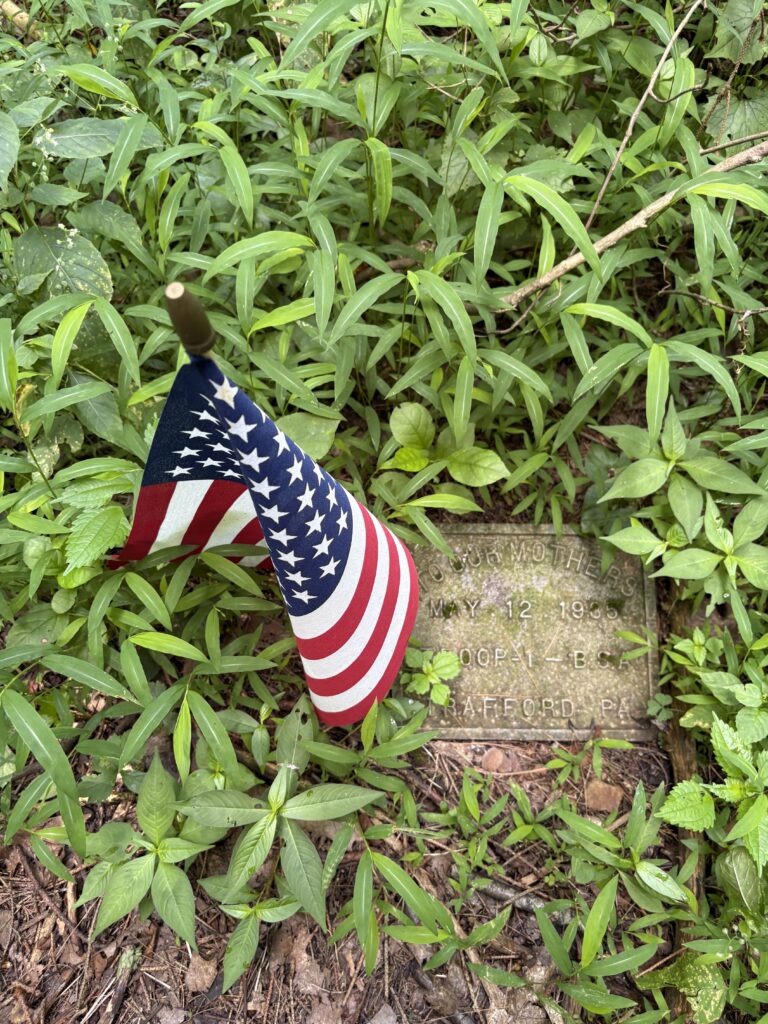
Between the passage of time alone and events in the interim, it’s likely that none of the hands that put the plaque there are still with us.
But still – the memory is there, the gesture is there, and the spirit is there. It’s another layer of battlefield history, unlikely to be randomly spotted but nonetheless important. Their gesture is as much of a reminder to ourselves to remember where we’ve come from.
There are two other markers there of deep symbolic importance, at least to me. These are two “witness trees,” as the guide described them – two trees that were believed to have been there at the time of the battle. The two trees, likely mere saplings at the time, survived not only the battle but the later farming, industrial development, the Boy Scouts honoring mom, and thousands of people who passed by over the decades and centuries and carved their initials into the bark. The bark holds these carvings, sometimes solos and sometimes paired, often with a heart between or around the initials. They even survived an EF1 tornado that hit the area in June, 2024.
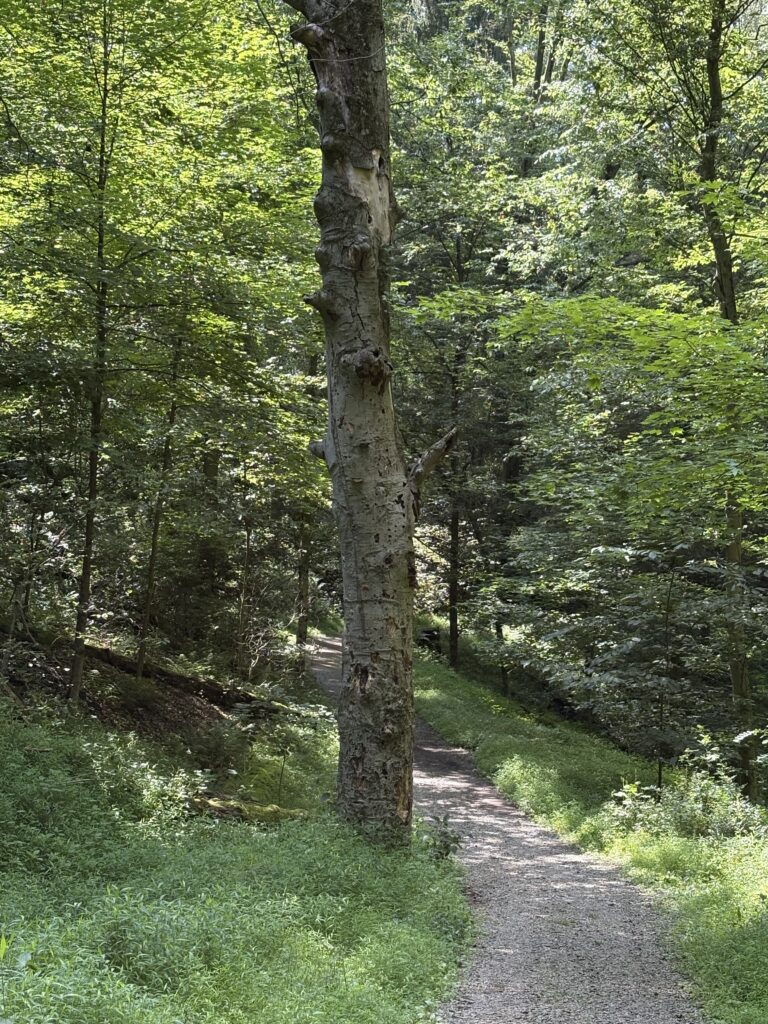
The trees are dying now, several hundred years old and riddled with woodpecker and insect damage. A couple of final shoots of leaves sprout in random spots from the trunk, the last surge of the old guard. Time passes; layers build. It’s up to us to be witnesses now. We have the luxury of being able to talk while the trees cannot…or, at least, in a language that we can communicate and understand.