Synthwave
September 13, 2026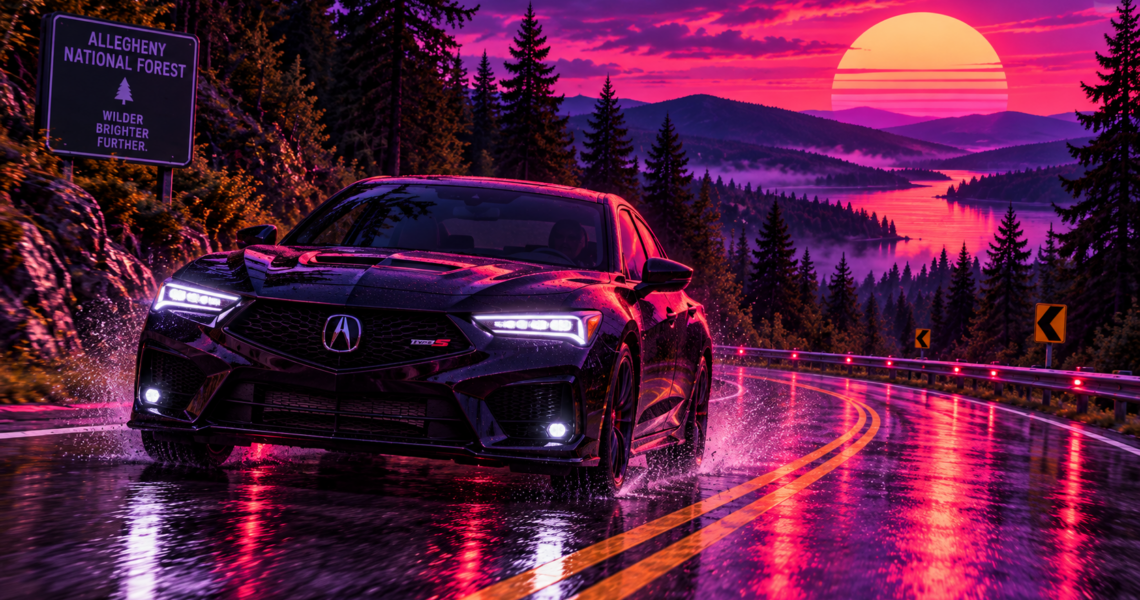
Theoretically, I could have put this entry under either blog, and maybe I’ll file it under both, as it is in one of those increasingly frequent intersections between my major interests, and that includes the utility and deployment of music.
Long sentence, but that’s what it is, all of it, right there: the connection between driving a machine and music.
I had occasion to think of this for a long while when I took a run to Bradford, in the northern part of the state, nearly at the New York border, where it is the home of a branch campus of the University of Pittsburgh…along with the factory for Zippo lighters and Case knives. Among the gas wells, national forest, craft manufacturing, a couple of excellent breweries and distilleries, one of the most renowned stargazing areas in the country, the site of a catastrophic dam failure in 1911, another catastrophic bridge collapse in 2003, the occasional wandering elk, some truly excellent driving roads, and oftentimes little or even no cell phone signal, I got into a synthwave kick.
This happens to me sometimes. Synthwave not familiar to you? If you’ve ever watched Stranger Things, the opening title music is exactly what I’m talking about. It’s a type of music redolent of the 1980s and the nostalgia suffusing, simmering, embedded in that decade. There’s usually a medium-paced techno-drum beat, some ethereal repeating synth, an arpeggio, around which the rest of the song harmonizes, like a tent expanding from a central post.
I’ve found synthwave to be an enormously helpful music to play in the background while I’m writing. I think the stuff I normally favor – generally metal or hard rock – is too guitar-focused, driving, and frankly lyrical, and it captures my attention rather than the screen or page in front of me. The instrumental music, especially a lighter and repetitive background, helps move things around inside my head, focusing my concentration on the act of writing.
That’s how it started, anyway – but when I was driving to Bradford, it was just a perfect late summer’s day, with an orange hue to the sun, some clouds, warm breeze, and Timecop1983 became my soundtrack of choice. (And admittedly, for at least the past 10-12 years or so, most times if someone hears what’s playing on my car speakers, it’s probably not going to be metal, contrary to my assertion of favorite genre above…in fact, there won’t be much music at all, but probably a podcast, and probably one on cars or motorsport at that!)
Another thing. At this point, I still have not watched the final two seasons of Stranger Things despite my early deep interest in it. When I was a kid, yes, I played D&D, and I also read Stephen King and Dean Koontz (tip of the hat to the Bedford County, PA native), so everything from the theme to the fonts used in the titles seemed directed right to my forebrain. But the later discovery of synthwave, at least for me, tended to create another route for me to explore that nostalgic 1980s remnant of it.
Which is funny, because though I grew up largely in the 1980s (with the 1990s as the finishing school, so to speak, lasting from high school, through college, a couple of years of employment, and law school…so I am an unhinged and unapologetic Gen-X, through and through), there are damned few cars from the 1980s that I’d own. I am somewhat curious about Grand Nationals, big-bodied Benz sedans, and I can be persuaded to look at square-bodied GM trucks and the bullnose and bricknose F-series Fords…even the occasional front-engine or air-cooled Porsches. But I’m not drawn to them. It’s a different realm of the aesthetic for me – it would be featuring one of my current vehicles (none of which are from the 1980s) with that synthwave background.
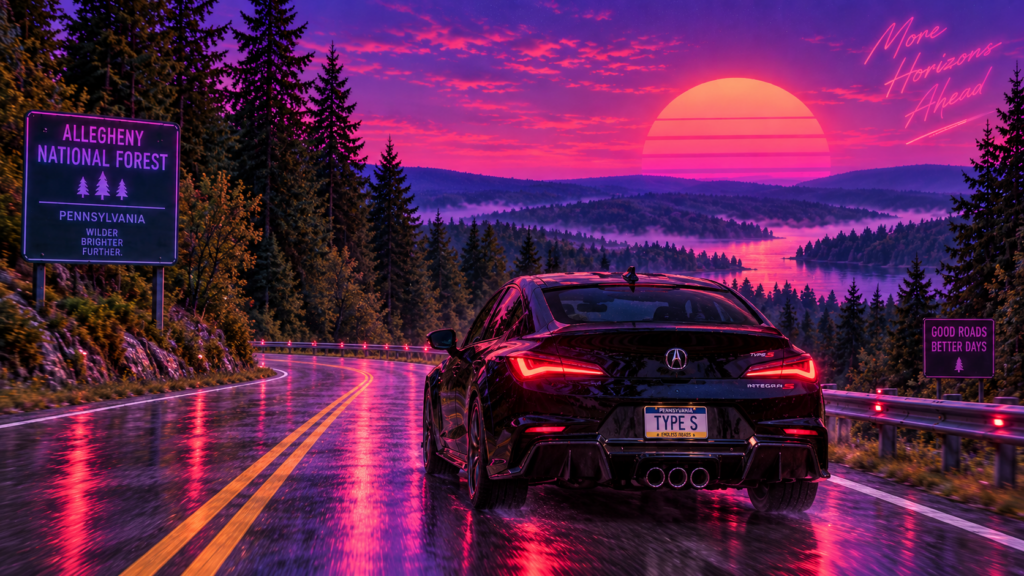
Synthwave roots itself, the internet tells me, in feelings of nostalgia. While I grew up in the 1980s, I don’t have any real reverence for them, except for that aesthetic. It occurred to me on this trip that synthwave doesn’t have to be nostalgia-forward. It can be just as evocative of a current state as a past one. I’m not nostalgic for 2003 (well, not any more than to remember what it was like to be 20-odd years younger) either, but that doesn’t mean I don’t like a car of that model year. So for me – the element of nostalgia is itself secondary, rather than the central production: the union of driving an athletic car on a back road, taking on a mission.
The thing about synthwave is that it looks back and reconstructs that past belief in the future. You’re there now, and you can feel free to yell at the music and say – no no no, you’ve gotten this all wrong. There’s an artificiality to the blind hope or fear that you had for the future, and you’re both right and wrong. Nothing that happens today is the same as we really pictured it in 1986 – but then again, everything happens now with the way we’ve pictured it: self-driving cars, talking and seemingly intelligent computers capable of holding conversations, instant global video communication…that future truly is now.
The retro-futuristic element is that which shadows the shape of a car’s soul. Car design is always of a time; that may not always be the right time, of course, but the embodiment of the design and engineering in an automobile is unmistakably and incontrovertibly the culmination of the thinking of designers, engineers, lawyers, accountants, and marketers.
It makes for a shape, for a manifestation of a person’s need for transport. Some cars are synthwavier than others…it’s hard to find one MORE of that vibe than an air-cooled 911 with the massive whale tail spoiler on the back. Just picture that framed in neon, pictured along the Pacific Coast Highway.
Synthwave may not be for you. As I’ve noted before and will again, your mileage may vary. But this is an important part of the driving ethos: the driving aesthetic. For me, it helps complete that mosaic of liberty and freedom that is the time behind the wheel, driving an amazing machine through astonishing beauty.