How Deep Was the Water? History, Fiction, and Verisimilitude
July 29, 2026Earlier, I mentioned verisimilitude and accuracy in writing. I’ll treat the subject in a future blog post on nonfiction in a bit more detail, but I wanted to use an example from These Restless Hills to illustrate the conflict—at least as I experienced it.
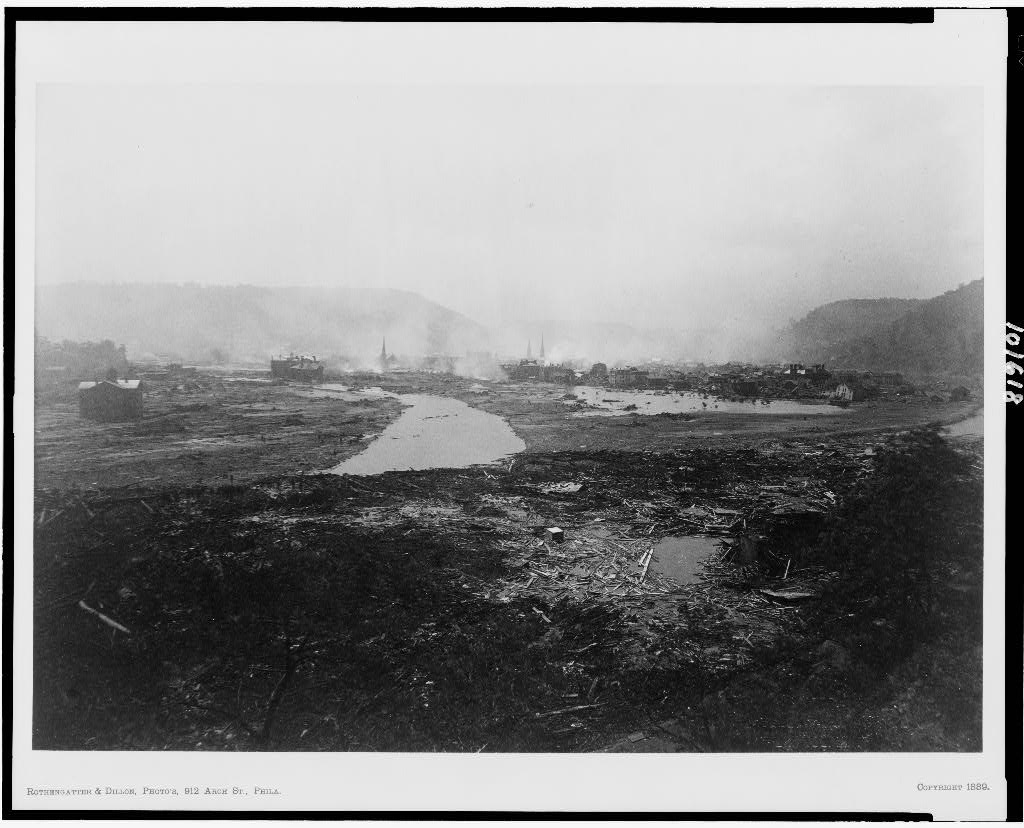
Immediately prior to the great flood of 1889, Johnstown was already flooded. It had water in the streets. There had been a fair bit of snow the winter prior and spring rains had been significant, generating swollen rivers and creeks all over the area. Indeed, Johnstown had a history of flooding – the notion of it being the “Flood City” was not triggered by the 1889 flood (although that certainly cemented it…had the floods of 1936 and 1977 not occurred, the moniker probably still would be there, given the magnitude of the 1889 flood.)
Why do I bring this up as an example?
Because it occasioned a semi-minor crisis during the revision cycle of the novel. There was a point where I had detected an inconsistency in what I had written about the level of water in the city. Because novels (generally and should) take longer to write than 7 minutes, and because I tend to look over and recirculate my research sources when working on a project, I had no actual idea of what the level of water was in the city prior to the catastrophic dam bursting. I had information ranging from ankle to knee to waist high water. Even by 19th century standards, the differences in relative inconvenience would have been pretty significant.
What did I do? Well – what any good scholar would do. I fudged the description. Indeed, this was plausibly more acceptable in a work of fiction given the fact that it is, well, fiction. However, for someone with my fealty to reality, that’s a difficult pill to swallow. My editor, probably beyond exasperated by my extraordinary pedantry to that point, tried to counsel me through the work by pointing toward any number of useful items to consider – its relationship to the plot, the characters, etc. Of course, it didn’t matter to any of those things…though it was linked inextricably to the setting, it wasn’t terribly material. What was material was getting to the climax at the same time the real flood arrived.
And much to my relief, I have yet to get a question during my public talks on the book along the lines of, “so…what are the best estimates for the water level in Johnstown in the hours leading up to the 1889 flood?” (And if I do now, I’ll have this handy blog entry in my pocket to blame if someone does bring it up.) The other reality is the flood water levels probably likely had significant variation, even as they do today in times of extreme weather conditions.
So – where does that leave us with verisimilitude? The obvious dividing line for me is nonfiction versus fiction. That’s an easy distinction that any six year old can make: the difference between real and make-believe. I do suspect that my own druthers begin to gravitate again, however, when it comes to historical fiction. My own place is not one of utter reverence to history, placing it on a pedestal and locked in with the belief framework of a dominant narrative. That’s not history – that’s bullshit.
My fealty to history is one of truth and, in areas where the sources are in conflict or you’re just dealing with an unknown (do we really know what George Washington was thinking when he boarded the boat to cross the Delaware? My first thought, having been on icy rivers duck hunting in December, would likely be that the future first President of the United States would have been thinking something along the lines of, “Christ, it’s cold”) is to give something a “close enough” description. Give the reader an idea of what it was like; that was the bigger truth afoot in TRH: the grimness of life itself, and there are plenty of relevant facts and details that can paint that picture for the reader.
Ultimately, how much water was there in Johnstown that day? Well, at one point, 20,000 or so people were going along their workday, as miserable as that might have been and then, a few hours later, more than 10% of them were dead. This is the percentage equivalent today of a disaster striking New York City and killing a million people.
The historical truth is that the carnage was akin to a nuclear bomb. That’s how many graves needed to be dug. That’s for bodies that were mangled into pieces and never put back together. That’s for those who died in the ensuing fire when, in the most likely scenario, an oil lamp lit fuel oil floating on the waters and it spread to structures and debris floating in the mess.
There’s truth, and that’s verisimilitude.