Anticipations of Maranello
June 16, 2026
So yes, that’s where Ferraris get made.
I’m also the first to admit I’ve never been a Ferrari fanboy, even being of the age when I’m able to remember watching Magnum PI with my mom when I was a little kid – and not when they were in repeat-season, either. The Ferrari was cool, but never my groove.
Why?
Because they were always unattainable. Even when you buy a clapped-out Ferrari for cheap, unless you have either mechanical talent or a lot of money (likely both) – a cheap selling price for a Ferrari will almost always lead to typical supercar recoupment, starting with oil changes and spark plugs. Unlike even a 911, a Ferrari oil change and spark plug upgrade is not to be taken lightly. Indeed – the litany of “engine out service” for any number of routine maintenance milestones is enough for me to tap out before we even get to the price of the car.
Nor have I been a Ferrari racing fanboy. The undeniable legacy is, of course, there, and I’ll also be the first to note my preference for Ferrari teams in the IMSA and WEC circuits more than F1 (but that’s more based on my antipathy toward F1 than Ferrari – and no, I don’t hate it. I just don’t like it that much. It’s okay, but again, not really my groove.)
No – most of the Ferrari thing for me has been a question of attainability. At the time of this writing, I earn a pretty good living. I’m able to sustain a couple of different resource-intensive hobbies (i.e., what happens to money is the same thing that happens when you pull the plug out of a tub drain – an inescapable force emptying the contents in a magnificent swirl.) I have a Porsche, after all, and that’s hardly a recipe for financial conservatism.
There is, however, a marked difference between owning a Porsche and owning a Ferrari. I understand that it is highly model dependent…until, of course, it isn’t. At the time of my writing this, the least expensive Ferrari for sale in the United States, model year 2001 or newer, so in the past 25 model years, is a 2012 Ferrari California offered at $68000, with 72,000 miles…and, let’s face it, 72,000 miles on any Ferrari is about the same as 272,000 on any other vehicle. (There’s also a silver 1985 Mondial with 66K…but I cannot recommend that path to anyone other than the devoted Ferrari mechanic/collector…who isn’t reading this anyway.) By contrast, the least expensive Stuttgart contingent is a miley 2005 Porsche Cayenne for $3900. The least expensive car-platform Porsche is a Boxster with more than 200k miles, for sale for about $6000. (I didn’t say any of these were good decisions, by the way – just options to entertain one if so inclined.)
So yes, there’s a difference. I always figured a Ferrari was out of reach and so, consequently, they’ve not interested me. I can’t deny the heritage, the beauty, the power, or any of the rest of the attributes of a Ferrari, and I have had the opportunity to drive them.
Which I have gladly done, especially on a race track. They are amazing, amazing machines – this is especially the case in the newest generations which, while sometimes lambasted for haptic controls and questionable styling, have on-track performance and on-road manners that might well be second to none, even in its own class of car.
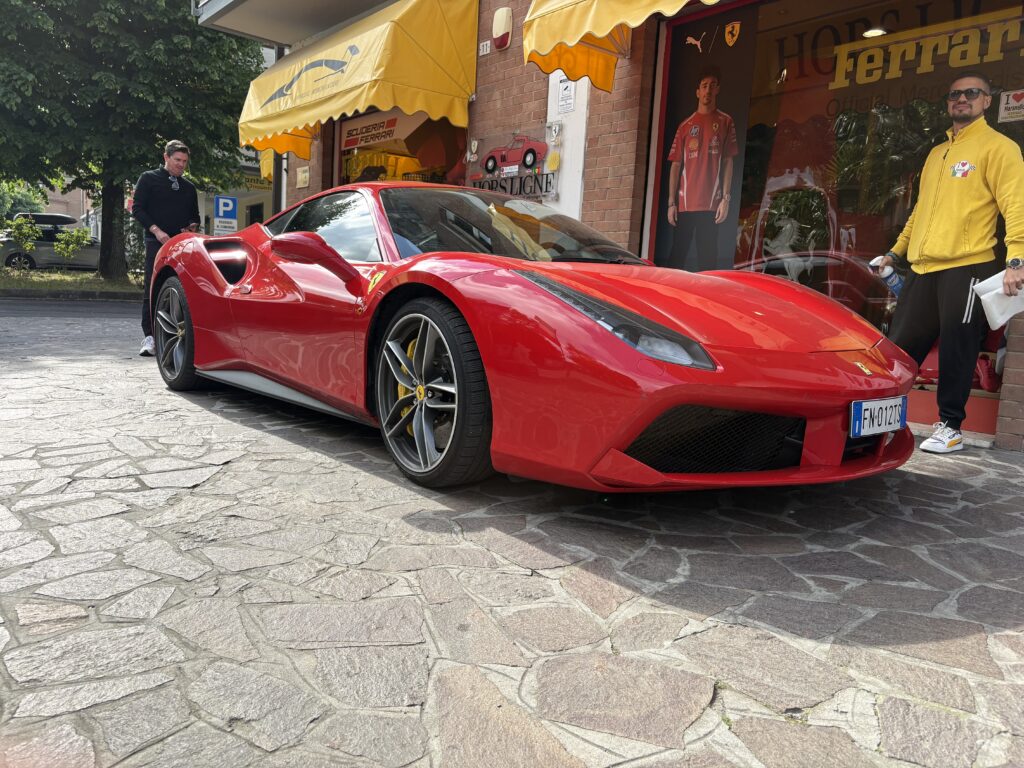
So we have established that I am not a member of the tifosi nor am I a mechanic, both of which are of significant aid in the Ferrari ownership experience. Nonetheless, one cannot ignore the romance of Maranello. When one sees this, one is immediately aware of motoring heritage, the outsized possibilities made manifest by the difficult and sometimes deeply irritating Enzo Ferrari.
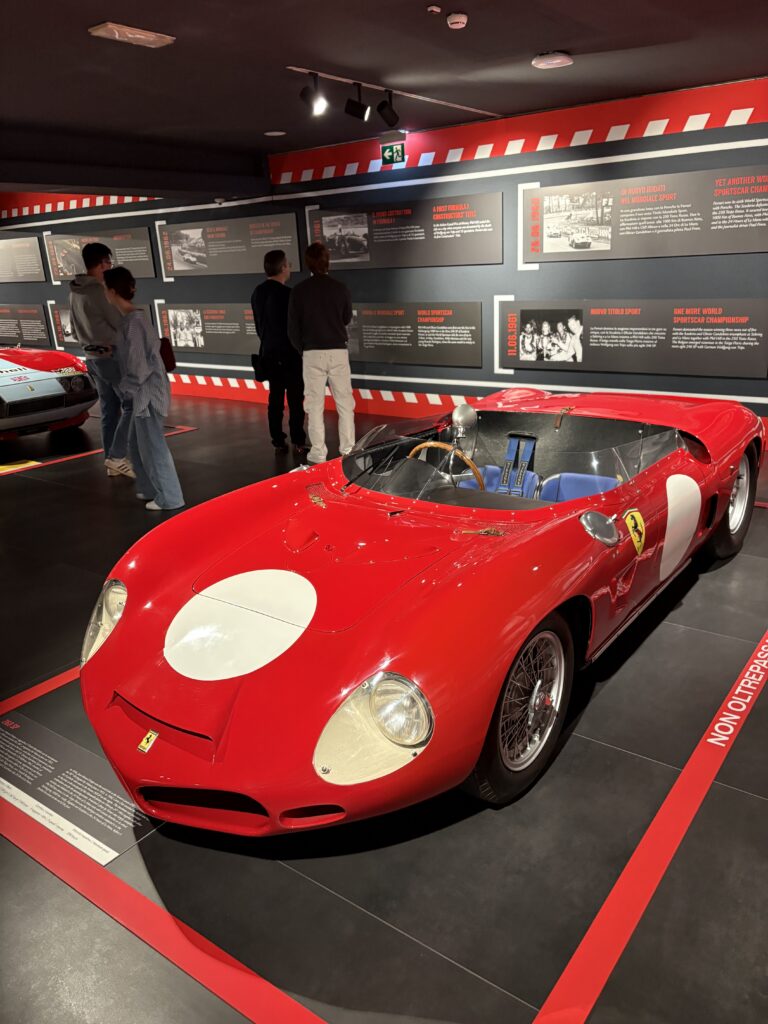
I have driven Ferraris, but this is the first visit to the home world of that esteemed and amazing brand. For some this would undoubtedly be a “pilgrimage” to use the vernacular of the overly enthusiastic enthusiast – for me, while Ferraris are a car for which I have great affection and admiration, this is a moment to explore history.
It is also, quite frankly, the opportunity to see the evolution of a philosophy that actually inspired the title of this sequence of essays: pixels and pistons. A Jalopnik article mentioned the same, quoting a business professor that stated: “[Chairman] John Elkann longs to trade pistons for pixels.”
Of course, in my view, that would be a great mistake. I’m not a billionaire, however, nor am I an Old World moneyed scion. I do believe the two can coexist. What, then, does Maranello teach us about trading these two…or keeping them both? When demigod and founder Enzo Ferrari was still alive, even whispers of the word “aerodynamic” would have likely been met with extreme scorn, just as having the engine anywhere but the front of the car would have been anathema. Why, Enzo would ask, would we put the horse behind the carriage? And things such as chassis and stability were for the “garagistas” who were unable to build an engine of sufficient power.
Even Enzo had to have a change in philosophy, though. As did the company itself at the beginning of the millennium – they were being soundly beaten by, of all things, an Acura…an Acura (or Honda) NSX…driven by a legendary Brazilian F1 driver by the name of Ayrton Senna.